How to Choose a Heat Protectant for Your Hair Type
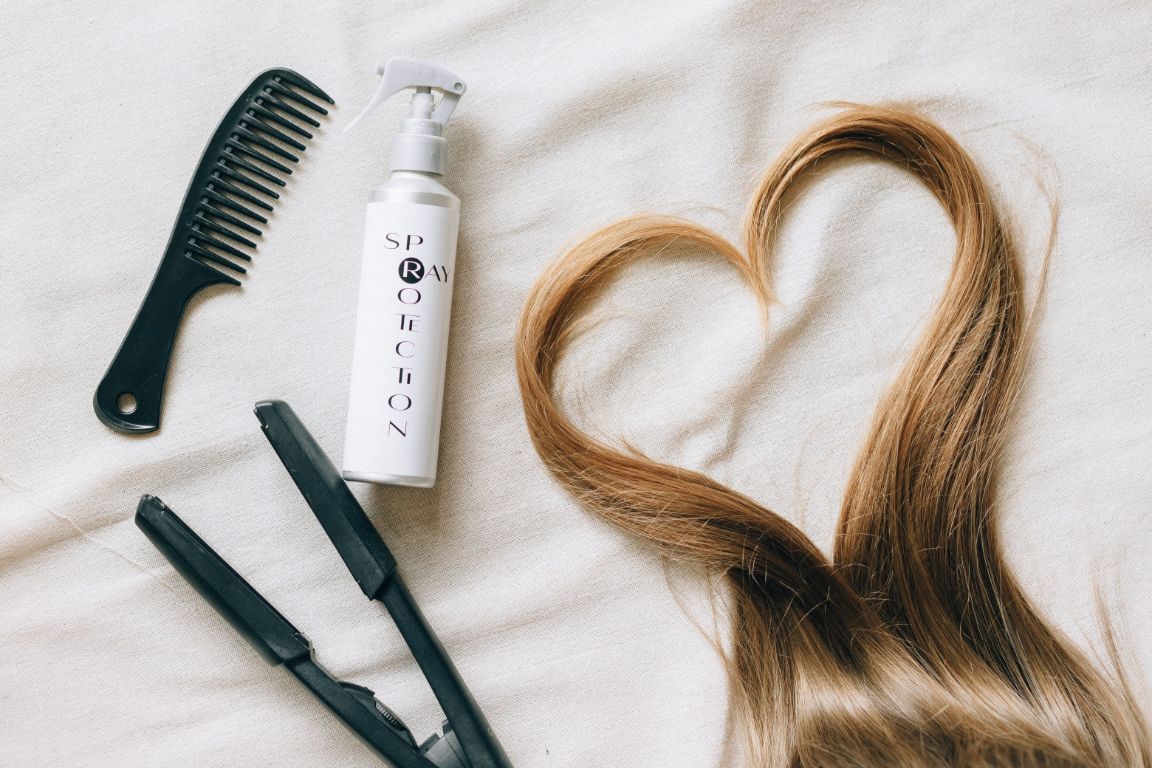
Heat protectant is designed to reduce the stress caused by blow dryers, curling irons, straighteners, and heated brushes. It cannot make hair completely resistant to high temperatures, but the right formula can help reduce moisture loss, improve slip, and make heated styling feel more manageable.
Choosing one is not simply a matter of buying the product with the highest temperature claim. Texture, hair density, styling method, and how much product you apply all affect the result.
Fine hair may need a lightweight spray that does not reduce volume. Thick or coarse hair may prefer a cream or serum that provides more control. Curly hair may benefit from a product that supports definition, while dry or processed hair often needs a richer formula used alongside lower heat.
This guide explains how to choose a heat protectant for your hair type, how different formats compare, and how to apply the product without leaving the hair greasy, stiff, or weighed down.
How to Choose a Heat Protectant at a Glance
Choose a heat protectant based on:
- Your hair thickness and density
- Whether your hair is straight, wavy, curly, or coily
- How dry or processed it feels
- The heated tool you use
- Whether you apply the product to damp or dry hair
- The amount of hold or smoothing you want
- How easily your hair becomes greasy or weighed down
- The temperature you normally use
A useful heat protectant should distribute evenly and leave the hair manageable without creating excessive buildup.
What Does Heat Protectant Do?
Heat protectants are formulated to create a lightweight layer over the hair.
Depending on the product, they may help:
- Reduce rapid moisture loss
- Improve slip during brushing
- Reduce friction
- Smooth the hair surface
- Make strands easier to manage
- Limit the rough feeling associated with repeated heat
- Reduce visible frizz
- Support a more even styling result
Heat protectant does not repair every form of damage or make unlimited heat safe.
Temperature, styling frequency, tool quality, and technique remain important.
Do You Really Need Heat Protectant?
Heat protectant is a useful step when you regularly use:
- Hair dryers
- Flat irons
- Curling irons
- Curling wands
- Heated brushes
- Hot combs
- Hot rollers
- Multi-styling tools
People who rarely use heat may not need a separate protectant every day.
Some leave-in conditioners and styling creams already include heat-protective claims. Check the label before adding another product.
Heat Protectant Spray vs Cream vs Serum
Heat protectants come in several formats.
Heat Protectant Spray
Sprays are usually lightweight and easy to distribute.
They may suit:
- Fine hair
- Straight hair
- Short hair
- Hair that becomes oily easily
- Blow-drying
- Quick styling routines
Advantages:
- Lightweight application
- Easy full-head coverage
- Less likely to reduce volume
- Convenient for damp or dry hair
Possible drawbacks:
- Easy to over-spray
- Some formulas feel sticky
- Coverage may be uneven when sprayed too far away
- Aerosol formulas may be difficult to control
Heat Protectant Cream
Creams provide more conditioning and control.
They may suit:
- Thick hair
- Coarse hair
- Dry hair
- Curly hair
- Long hair
- Frizz-prone hair
Advantages:
- Easier to control by section
- Adds softness
- Helps with detangling
- May improve smoothing
Possible drawbacks:
- Can weigh down fine hair
- Too much may make roots greasy
- May take longer to distribute
Heat Protectant Serum
Serums often provide slip and shine.
They may suit:
- Thick hair
- Coarse hair
- Dry ends
- Straightening routines
- Hair prone to visible frizz
Advantages:
- Smooth finish
- Concentrated application
- Useful on ends
- Often improves shine
Possible drawbacks:
- Easy to overapply
- May feel oily
- Not always suitable near the roots
- Some formulas are designed for finishing rather than pre-heat use
Always confirm that the serum is specifically labeled for heat protection.
Heat Protectant Oil
Some hair oils include heat-protective claims.
They may suit:
- Coarse hair
- Very dry lengths
- Thick hair
- Textured hair
Use oils carefully because applying too much can make the hair heavy.
Do not assume that every natural oil is suitable for use before a heated tool. Use a product specifically formulated and labeled for heated styling.
Heat Protectant Mousse or Foam
Foams combine heat protection with styling support.
They may suit:
- Fine hair
- Wavy hair
- Volume-focused blowouts
- Short hairstyles
- Hair that needs light hold
They can help add body while preventing the hair from feeling coated with cream.
Heat Protectant for Fine Hair
Fine hair is easily weighed down, so lightweight formulas are usually best.
Look for:
- Fine mist sprays
- Lightweight foam
- Low-residue formulas
- Volumizing heat protectants
- Products designed for fine hair
- Minimal heavy oils or butters
Apply lightly through the mid-lengths and ends.
Avoid saturating the roots unless the product is specifically designed for root application.
Related guide: Best Heat Protectants for Fine Hair
How Much Should Fine Hair Use?
Begin with a small amount.
For a spray:
- Divide hair into sections.
- Mist lightly from several inches away.
- Comb through.
- Add more only to areas that feel uncovered.
For a cream:
- Use a pea-sized amount or less.
- Rub it between your palms.
- Apply mainly to the lengths and ends.
Fine hair often looks greasy because of excess product rather than the product category itself.
Heat Protectant for Thick Hair
Thick hair often needs more product and more careful sectioning.
Look for:
- Cream sprays
- Leave-in creams
- Smoothing lotions
- Serums
- Products with detangling benefits
- Formulas designed for high-density hair
Apply section by section so the inner layers are covered.
A single spray over the outer surface may not reach the full head.
Heat Protectant for Coarse Hair
Coarse strands may prefer richer formulas that improve softness and control.
Consider:
- Cream heat protectants
- Smoothing balms
- Heat-protective serums
- Leave-in conditioners
- Lightweight oils formulated for heat
Apply evenly through the lengths.
Use a comb or brush to distribute the product before styling.
Heat Protectant for Curly Hair
Curly hair often benefits from heat protectant that also supports moisture and definition.
Look for:
- Leave-in creams
- Curl-supporting sprays
- Lightweight milks
- Anti-frizz formulas
- Products compatible with diffusing
- Flexible-hold products
When diffusing, use enough product to cover the curls without making them stiff.
Avoid repeatedly touching the hair during drying because this can disturb the curl pattern.
Heat Protectant for Wavy Hair
Wavy hair may need balance between definition and lightness.
Good options include:
- Lightweight cream
- Fine mist spray
- Mousse
- Curl milk
- Flexible-hold heat protectant
Apply more to the ends and less near the roots.
A heavy cream may flatten loose waves.
Heat Protectant for Coily or Textured Hair
Coily and tightly textured hair may benefit from richer heat protectants with strong slip.
Look for:
- Cream formulas
- Leave-in conditioners with heat protection
- Detangling benefits
- Smoothing serums
- Products designed for stretching or blow-drying textured hair
Apply carefully by section.
Make sure the hair is detangled before using high-tension tools.
Lower temperatures and fewer passes are generally more important than relying on product alone.
Heat Protectant for Dry Hair
Dry hair often needs a formula that combines heat protection with conditioning.
Look for:
- Creams
- Milks
- Leave-in conditioners
- Serums
- Ceramides
- Amino acids
- Squalane
- Lightweight oils
- Humectants such as glycerin
Avoid products that leave the hair stiff or crunchy unless hold is part of the intended style.
Dry hair may also benefit from partial air drying before heated styling.
Heat Protectant for Damaged or Fragile Hair
Hair that feels fragile should be styled cautiously.
Look for:
- Lightweight leave-in conditioner
- Bond-supporting formulas
- Protein-containing products when suitable
- Ceramide-based formulas
- Flexible creams
- Detangling heat protectants
More product does not provide unlimited protection.
Also consider:
- Lower heat
- Shorter styling time
- Fewer passes
- Less brush tension
- Reduced use of multiple hot tools
Hair that is breaking frequently may need a break from heated styling.
Heat Protectant for Color-Treated Hair
Color-treated hair may feel drier and may fade with repeated high heat.
Look for:
- Products labeled for color-treated hair
- Moisturizing heat protectants
- UV-protective claims when desired
- Smoothing creams
- Lightweight leave-ins
- Formulas that reduce repeated styling passes
Use moderate temperatures and avoid holding the tool on one section for too long.
Heat Protectant for Bleached Hair
Bleached hair may be more porous and fragile.
Choose:
- Cream or milk formulas
- Bond-supporting products
- Gentle detangling sprays
- Moisturizing leave-ins
- Heat protectants designed for processed hair
Use the lowest effective temperature.
Avoid stacking blow drying, straightening, and curling in the same routine whenever possible.
Heat Protectant for Oily Hair
Oily hair may still need heat protection, but lighter textures are usually easier to manage.
Look for:
- Fine mist spray
- Oil-free formula
- Lightweight mousse
- Root-friendly volumizing product
- Fast-drying spray
Apply most of the product to the lengths rather than the scalp.
Avoid heavy creams near the roots.
Heat Protectant for Short Hair
Short hair requires less product.
Useful formats include:
- Spray
- Mousse
- Lightweight cream
- Styling lotion with heat protection
Apply a small amount and distribute it thoroughly.
Because short hair dries quickly, low or medium heat is often enough.
Heat Protectant for Long Hair
Long hair needs more careful coverage.
Apply in sections and pay attention to:
- Mid-lengths
- Ends
- Underlayers
- Areas near the face
- Frequently restyled sections
Long ends may already be older and drier, so they may need slightly more product than the roots.
Best Heat Protectant for Blow-Drying
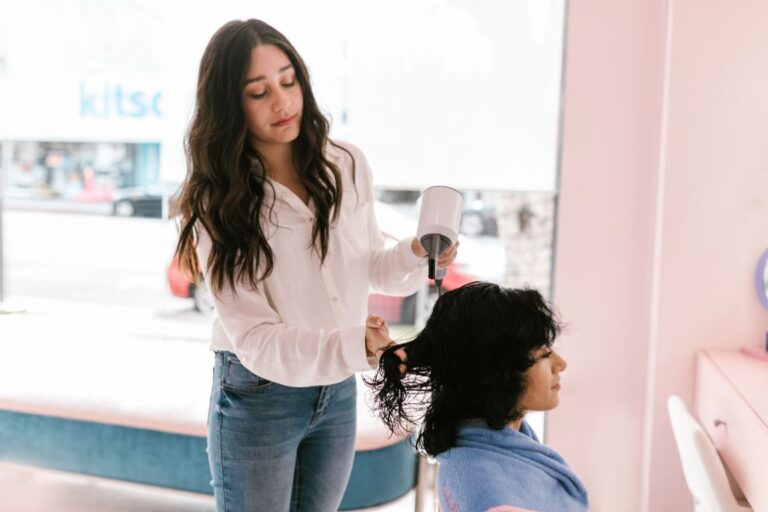
For blow-drying, choose a formula that can be used on damp hair.
Good options include:
- Spray
- Leave-in conditioner
- Cream
- Mousse
- Styling lotion
The product should support:
- Detangling
- Slip
- Smoothing
- Faster styling
- Reduced brush friction
Apply after towel drying and before sectioning.
Related guide: How to Use a Hair Dryer Without Excessive Heat Damage
Best Heat Protectant for Flat Ironing
For flat ironing, choose a product specifically labeled for use with high-temperature tools.
Useful formats include:
- Dry heat-protectant spray
- Lightweight serum
- Smoothing spray
- Anti-humidity protectant
Hair should be completely dry before using a standard flat iron.
Applying a wet product immediately before straightening may cause the hair to feel damp and increase sizzling or steam.
Allow the protectant to dry fully before using the tool.
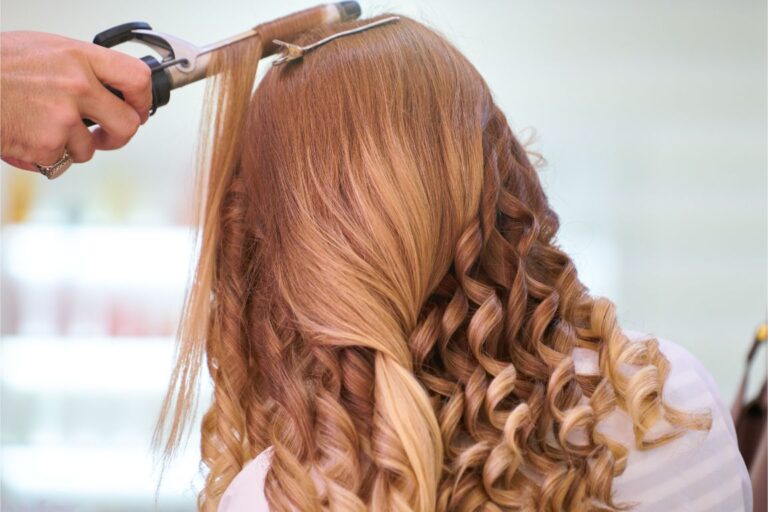
Best Heat Protectant for Curling Irons
Curling irons work best with products that protect without making hair too slippery.
Look for:
- Dry spray
- Lightweight mist
- Flexible-hold protectant
- Fine-hair formula when needed
Very oily products can make curls fall more quickly.
Apply evenly and allow the hair to dry before curling.
Related guide: How to Choose the Right Curling Iron Barrel Size
Best Heat Protectant for Heated Brushes
Heated brushes combine heat with direct brushing.
Choose a product that provides:
- Slip
- Detangling
- Lightweight protection
- Smoothing
- Low residue
Avoid applying so much product that the brush becomes coated.
Clean the heated brush according to its instructions after it cools.
Damp-Hair vs Dry-Hair Heat Protectant
Not all heat protectants are used the same way.
Damp-Hair Heat Protectant
Designed for:
- Blow drying
- Diffusing
- Heated brush drying
- Styling from damp hair
Common formats:
- Leave-in cream
- Milk
- Spray
- Mousse
Dry-Hair Heat Protectant
Designed for:
- Flat irons
- Curling irons
- Curling wands
- Restyling dry hair
Common formats:
- Dry mist
- Lightweight spray
- Serum
- Finishing protectant
Some products work on both damp and dry hair.
Always follow the instructions on the label.
Can You Use Damp-Hair Protectant on Dry Hair?
Only when the product states that it can be used that way.
A damp-hair cream or spray may make dry hair too wet for immediate flat ironing or curling.
When restyling dry hair, use a product designed for dry application and let it settle before adding heat.
What Temperature Protection Should You Look For?
Many products advertise protection up to a specific temperature.
Common claims may include protection up to:
- 350°F
- 400°F
- 425°F
- 450°F
A higher number does not mean you should automatically style at that temperature.
Use the lowest heat setting that gives you the desired result.
Product claims also depend on correct application and even coverage.
What Heat Setting Should You Use?
General starting points include:
- Fine or fragile hair: low heat
- Normal hair: low to medium heat
- Thick or coarse hair: medium heat
- Processed hair: lower heat and fewer passes
Tool temperature displays are not always perfectly accurate.
Begin lower and increase only when necessary.
Ingredients Commonly Found in Heat Protectants
Heat protectants may include several ingredient types.
Silicones
Common silicones include:
- Dimethicone
- Amodimethicone
- Cyclopentasiloxane
- Phenyl trimethicone
They may help create slip, reduce friction, and smooth the hair surface.
Some people avoid silicones because of buildup concerns, but they can be useful in heated styling products.
Regular cleansing can help manage residue.
Polymers
Film-forming polymers create a lightweight coating over the hair.
They may support:
- Heat protection
- Hold
- Frizz control
- Smoother styling
Proteins and Amino Acids
Some formulas include:
- Hydrolyzed keratin
- Wheat protein
- Silk amino acids
- Rice protein
- Peptides
These ingredients may improve the feel of damaged or porous hair.
Protein-heavy products may leave some hair feeling stiff, so balance them with moisturizing products when needed.
Humectants
Humectants attract water.
Examples include:
- Glycerin
- Panthenol
- Propylene glycol
- Hyaluronic acid
They may support softness, though very humid conditions can change how some formulas behave.
Oils and Emollients
Common examples include:
- Argan oil
- Squalane
- Jojoba oil
- Sunflower oil
- Coconut-derived ingredients
These can improve softness and shine but may feel heavy on fine hair.
Do Silicone-Free Heat Protectants Work?
Silicone-free products can provide heat protection through polymers, proteins, and conditioning ingredients.
However, silicone-free does not automatically mean better or gentler.
Choose based on:
- Hair response
- Styling performance
- Buildup
- Ease of washing
- Preferred texture
Silicones can be useful for reducing friction and improving slip.
How to Apply Heat Protectant Properly
Correct application is essential.
A basic method:
- Towel-dry the hair gently.
- Divide it into sections.
- Apply the protectant evenly.
- Focus on mid-lengths and ends.
- Add a small amount to the upper sections.
- Comb or brush through.
- Allow the product to distribute.
- Begin styling.
For dry-hair formulas, apply only to completely dry hair and let the product settle before using the tool.
Should Heat Protectant Go on Wet or Dry Hair?
It depends on the product.
Use damp-hair protectant before:
- Blow drying
- Diffusing
- Blowout brushes
Use dry-hair protectant before:
- Curling
- Flat ironing
- Dry restyling
Check the label instead of assuming one product works for every method.
How Much Heat Protectant Should You Use?
The correct amount depends on:
- Hair length
- Density
- Product format
- Spray pattern
- Hair texture
For spray:
- Apply a light, even mist by section.
- Avoid soaking the hair.
- Comb through.
For cream:
- Begin with a pea-sized amount.
- Add more for long or thick hair.
- Avoid coating the roots heavily.
For serum:
- Start with one or two drops.
- Concentrate on the ends.
Uneven coverage reduces usefulness, but excess product can create buildup.
Should You Comb Heat Protectant Through?
Yes.
Combing or brushing helps distribute the product more evenly.
Use:
- Wide-tooth comb
- Detangling brush
- Fingers
- Vent brush
Be gentle because damp hair can stretch and break more easily.
How Long Should Heat Protectant Dry Before Styling?
For damp-hair blow-drying products, you can usually begin after even distribution.
For dry-hair protectants:
- Allow the spray to settle.
- Make sure the hair no longer feels damp.
- Avoid placing a hot tool on wet product.
The product instructions should provide the best guidance.
Should You Reapply Heat Protectant?
Reapplication may be useful when:
- Styling on a different day
- Using another heated tool later
- Washing and restyling
- The product instructions recommend it
You do not necessarily need to reapply between every pass during the same styling session.
Too much layering may create residue.
Can You Use Heat Protectant Every Day?
Many heat protectants are designed for regular use, but daily heated styling may still leave hair dry over time.
When using heat frequently:
- Choose lower temperatures.
- Limit repeated passes.
- Use a gentle shampoo.
- Clarify when buildup develops.
- Condition the hair regularly.
- Include heat-free days.
The product reduces risk but does not remove it completely.
Can Leave-In Conditioner Replace Heat Protectant?
Only when the leave-in conditioner specifically includes heat protection.
A standard leave-in may improve softness and detangling but may not be formulated or tested for heated styling.
Check the label for:
- Heat protection
- Thermal protection
- Blow-dry protection
- Styling temperature claims
Can Hairspray Be Used as Heat Protectant?
Hairspray and heat protectant serve different purposes.
Some styling sprays combine hold with heat protection, but standard hairspray should not automatically be treated as a protectant.
Use a product specifically labeled for both functions.
Can Hair Oil Replace Heat Protectant?
Only when the oil product specifically states that it provides thermal protection.
Applying ordinary cosmetic oil before high heat is not the same as using a formulated heat protectant.
Choose products designed for heated tools.
Why Does Heat Protectant Make Hair Greasy?
Common causes include:
- Applying too much
- Using a formula that is too rich
- Placing it directly on the roots
- Combining several leave-in products
- Using oil and cream together
- Not washing away previous buildup
Try:
- Using less
- Switching to a mist
- Applying only to the lengths
- Clarifying occasionally
- Avoiding overlapping products
Why Does Heat Protectant Make Hair Stiff?
Stiffness may come from:
- Strong-hold polymers
- Protein-heavy formulas
- Excess product
- Uneven application
- Hairspray-like ingredients
Choose a flexible or soft-finish formula when you do not need hold.
Why Does Heat Protectant Make Hair Sticky?
Stickiness may occur when:
- Too much product is applied
- Layers have not dried
- The formula contains strong styling polymers
- Hair is styled before the spray settles
- Multiple sticky products are combined
Use smaller amounts and allow each layer to dry.
Why Does Hair Still Feel Dry After Using Heat Protectant?
Heat protectant cannot compensate for:
- Very high temperatures
- Frequent passes
- Long contact time
- Repeated daily styling
- Rough brushing
- Existing damage
- Lack of conditioning
Lower the heat and shorten the styling process.
A richer conditioning routine may also be needed.
Common Heat-Protectant Mistakes
Applying only to the top layer
The inner sections may remain unprotected.
Using too much
Excess product can make the hair greasy or stiff.
Applying too little to long or thick hair
Coverage may be uneven.
Using the wrong format
A heavy cream may flatten fine hair, while a light mist may not provide enough control for coarse hair.
Styling while the hair is still wet
Standard flat irons and curling tools should be used on dry hair unless specifically designed otherwise.
Relying on the product while using maximum heat
Heat protectant does not make unlimited temperature safe.
Skipping sectioning
Sectioning improves both coverage and styling efficiency.
Applying ordinary oil before high heat
Use a product specifically formulated for thermal styling.
Making too many passes
Repeated passes increase heat exposure.
How to Reduce Heat Exposure Beyond Using Protectant
Heat protectant is only one part of a gentler routine.
Also consider:
- Partial air drying
- Lower heat settings
- Faster airflow when blow drying
- Proper sectioning
- Cleaning tool plates and barrels
- Replacing damaged tools
- Avoiding repeated passes
- Allowing curls to cool rather than reheating them
- Using heat-free styles between sessions
A Simple Blow-Dry Routine
- Gently towel-dry the hair.
- Apply damp-hair heat protectant.
- Detangle.
- Divide into sections.
- Use low or medium heat.
- Keep the dryer moving.
- Stop when each section is dry.
- Finish with cool air when desired.
A Simple Flat-Iron Routine
- Make sure the hair is completely dry.
- Apply a dry-hair heat protectant.
- Let the product settle.
- Divide the hair into small sections.
- Use the lowest effective temperature.
- Make one controlled pass.
- Repeat only when necessary.
A Simple Curling-Iron Routine
- Begin with dry hair.
- Apply dry heat-protectant spray.
- Let it settle.
- Divide the hair into sections.
- Choose the correct barrel size.
- Use moderate heat.
- Hold each section only as long as needed.
- Allow the curl to cool before touching it.
Frequently Asked Questions
What type of heat protectant is best?
The best type depends on your hair. Fine hair often suits sprays, while thick, coarse, dry, or curly hair may prefer creams or serums.
Should heat protectant be applied to wet or dry hair?
Use it according to the label. Damp-hair products are commonly used before blow drying, while dry sprays are designed for curling or straightening.
How much heat protectant should I use?
Use enough to cover the hair evenly without saturating it. Begin with a small amount and distribute it by section.
Does heat protectant completely prevent damage?
No. It may reduce heat-related stress, but temperature, frequency, contact time, and technique still matter.
Can I use leave-in conditioner as heat protectant?
Only when the leave-in specifically states that it offers thermal protection.
Can I put heat protectant on my roots?
Yes, when the formula is lightweight and designed for full-head use. Fine or oily hair may prefer to keep richer products away from the roots.
Should heat protectant dry before straightening?
Yes. Hair should be completely dry before using a standard flat iron.
Is spray or cream heat protectant better?
Spray is usually lighter and suits fine hair. Cream offers more control and conditioning for thick, dry, coarse, or curly hair.
Final Thoughts
Choosing a heat protectant begins with matching the product texture to your hair and styling routine.
Fine or oily hair often works best with a lightweight mist or foam. Thick, coarse, curly, or dry hair may benefit from a cream, milk, or serum that provides more slip and control. Color-treated and fragile hair should be paired with lower temperatures and fewer passes.
Apply the product evenly, section the hair, and make sure it is suitable for damp or dry application before using your tool.
Heat protectant is most effective when it is part of a complete approach that also includes moderate temperatures, efficient technique, and fewer unnecessary passes.